
Research Vision#
My research develops physics-guided intelligent systems for sensing, interpreting, modelling, and decision-making in civil infrastructure.
The central idea is to combine structural dynamics, sensing technologies, scientific computing, and artificial intelligence so that structural health monitoring moves beyond data collection toward diagnosis, prediction, uncertainty-aware interpretation, and practical decision support.
Research Thrust Areas#
T1
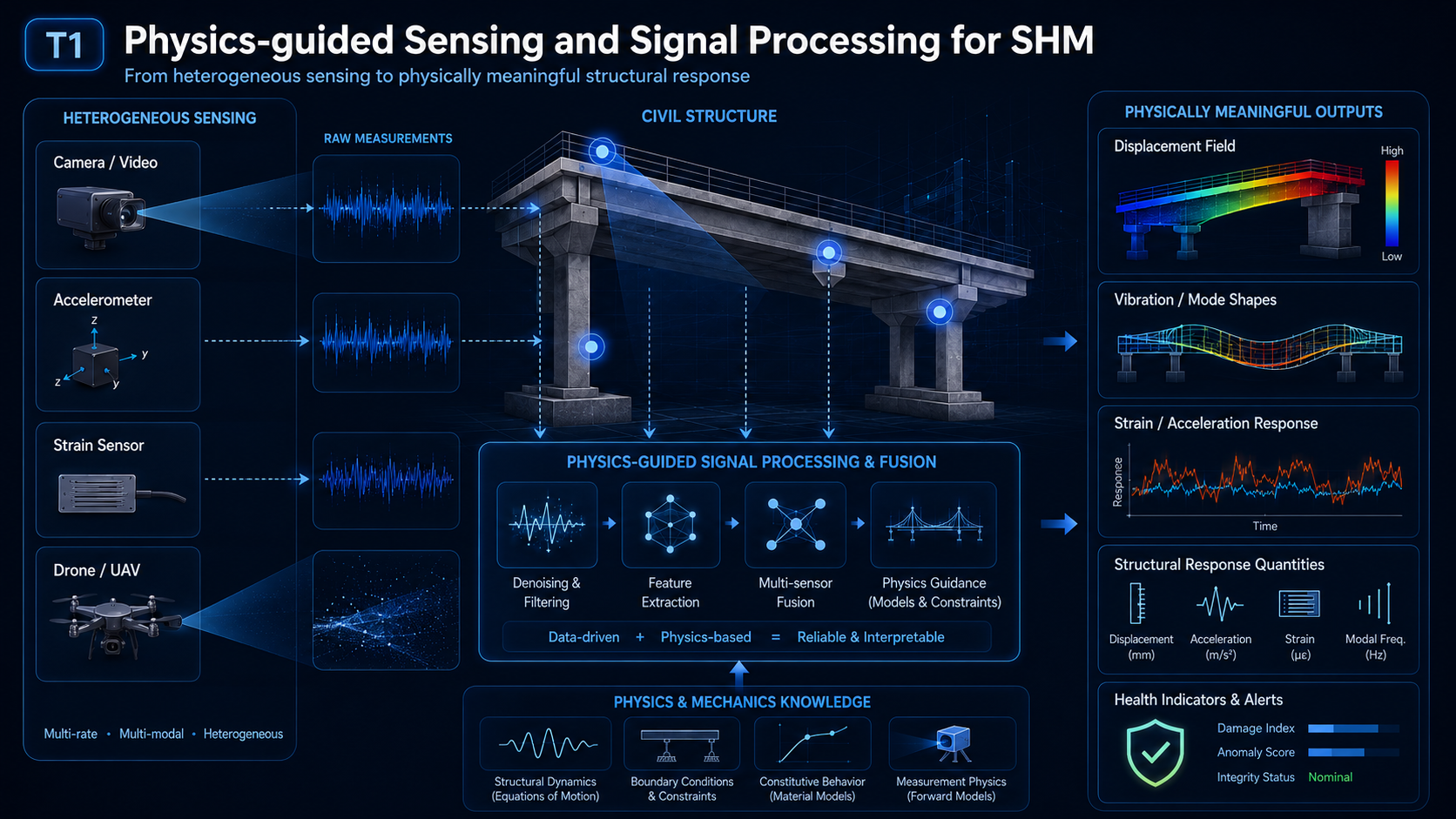
Physics-guided Sensing and Signal Processing for SHM#
This thrust focuses on converting measurements from cameras, accelerometers, strain sensors, drones, and heterogeneous monitoring systems into physically meaningful structural response quantities.
The goal is to develop sensing and signal-processing methods that are not purely data-driven, but are guided by structural dynamics, measurement physics, and mechanics-based constraints.
Representative directions: SRDD-based derivative estimation, physics-informed computer vision, multi-rate sensor fusion, full-field strain prediction, night-time SHM, drone-based and drive-by monitoring.
T2
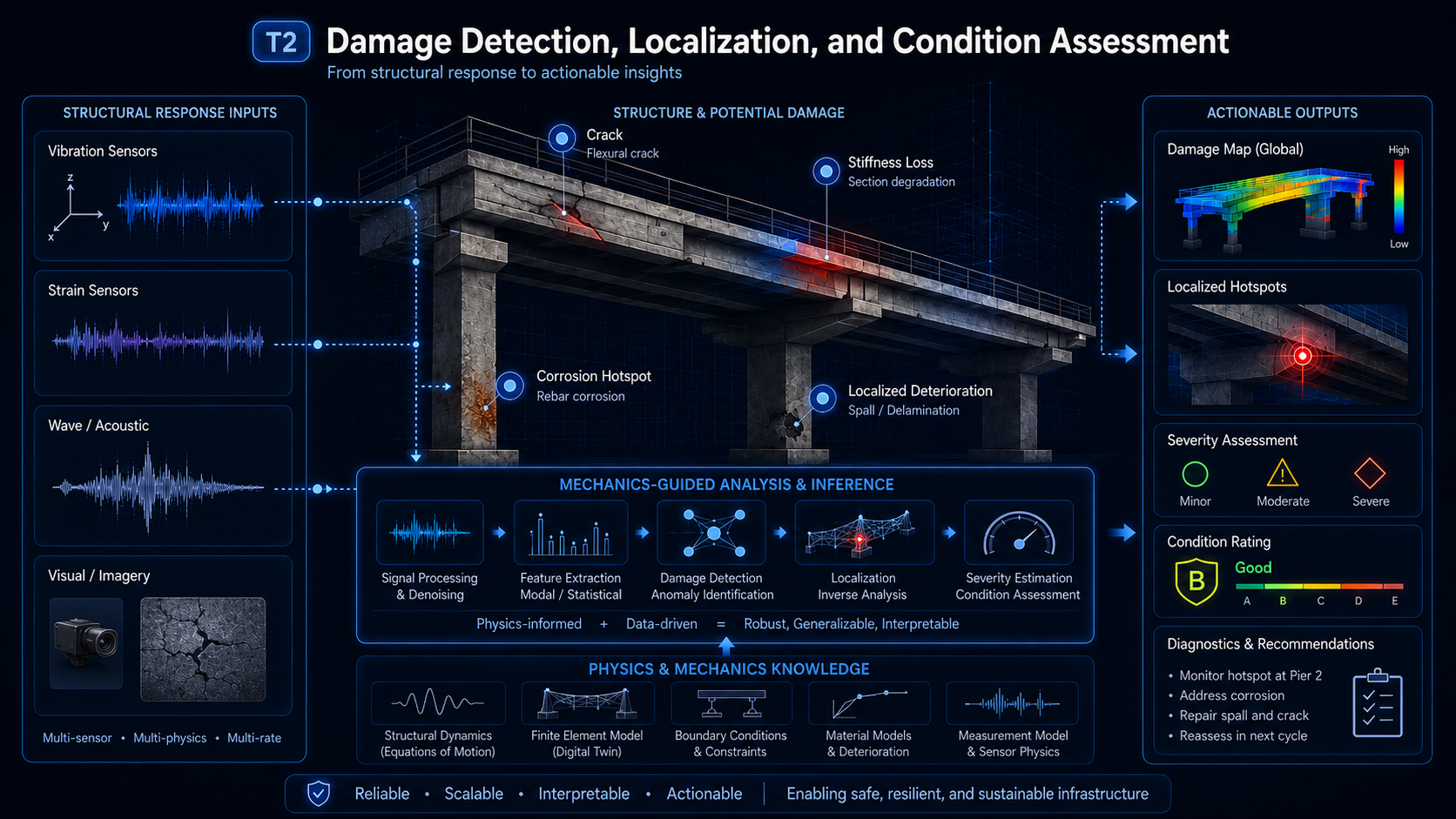
Damage Detection, Localization, and Condition Assessment#
This thrust develops methods to detect, localize, and interpret structural damage from vibration, strain, wave propagation, and global response data.
A key goal is to move toward reliable damage diagnosis even when healthy baseline data are unavailable, which is a common challenge for existing civil infrastructure.
Representative directions: spline-based damage indicators, baseline-free localization, wave attenuation through cracks, KAN-based damage classification, PDE-guided response dictionaries.
T3
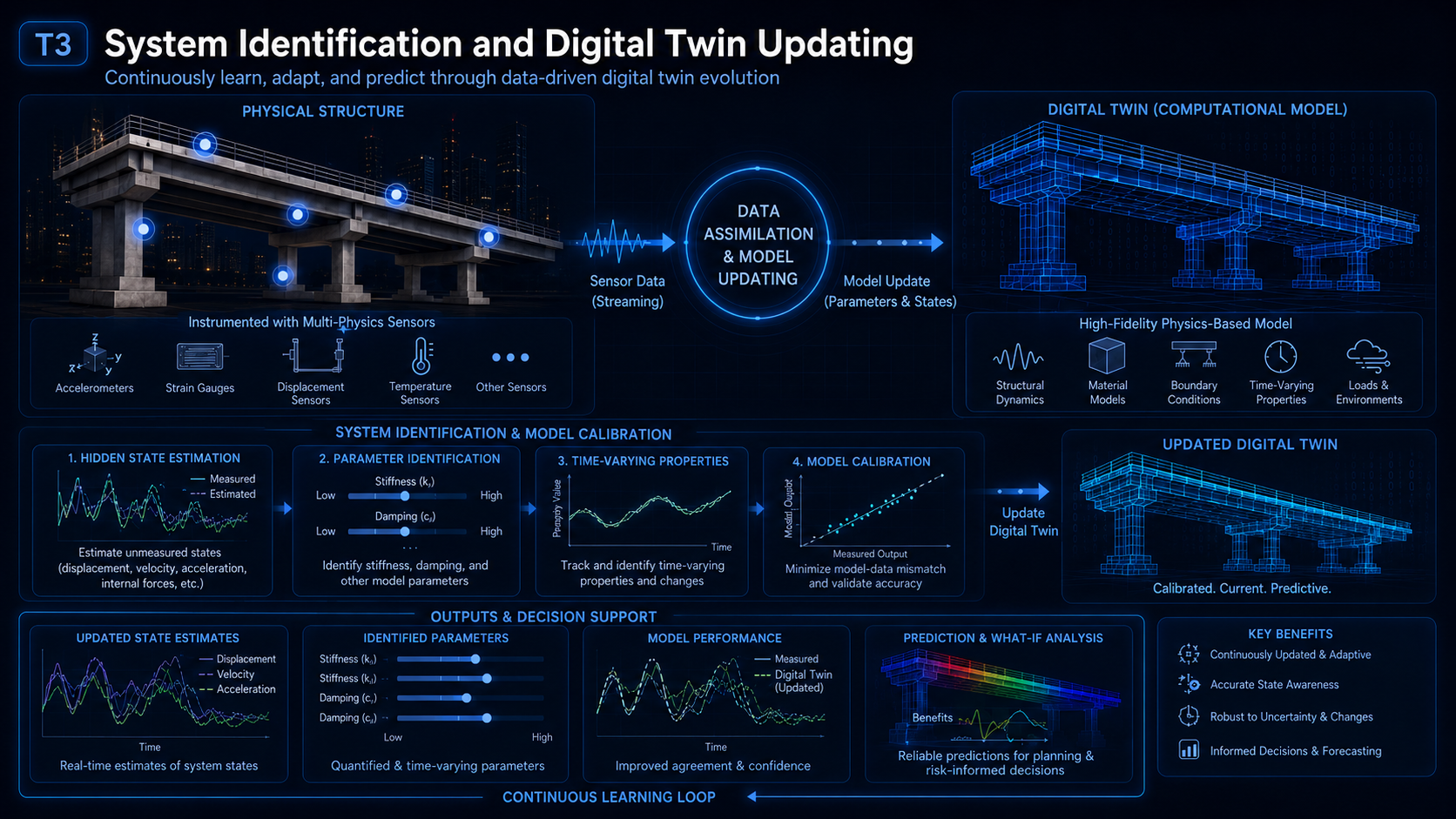
System Identification and Digital Twin Updating#
This thrust focuses on identifying structural parameters, hidden states, changing properties, and full-field response quantities from measured data.
The long-term objective is to support digital twins that are continuously updated using monitoring data and can represent the evolving condition of real structures.
Representative directions: SRDD-enhanced state estimation, time-varying stiffness and damping identification, non-stationary response modelling, sparse-to-full-field reconstruction, digital twin updating.
T4
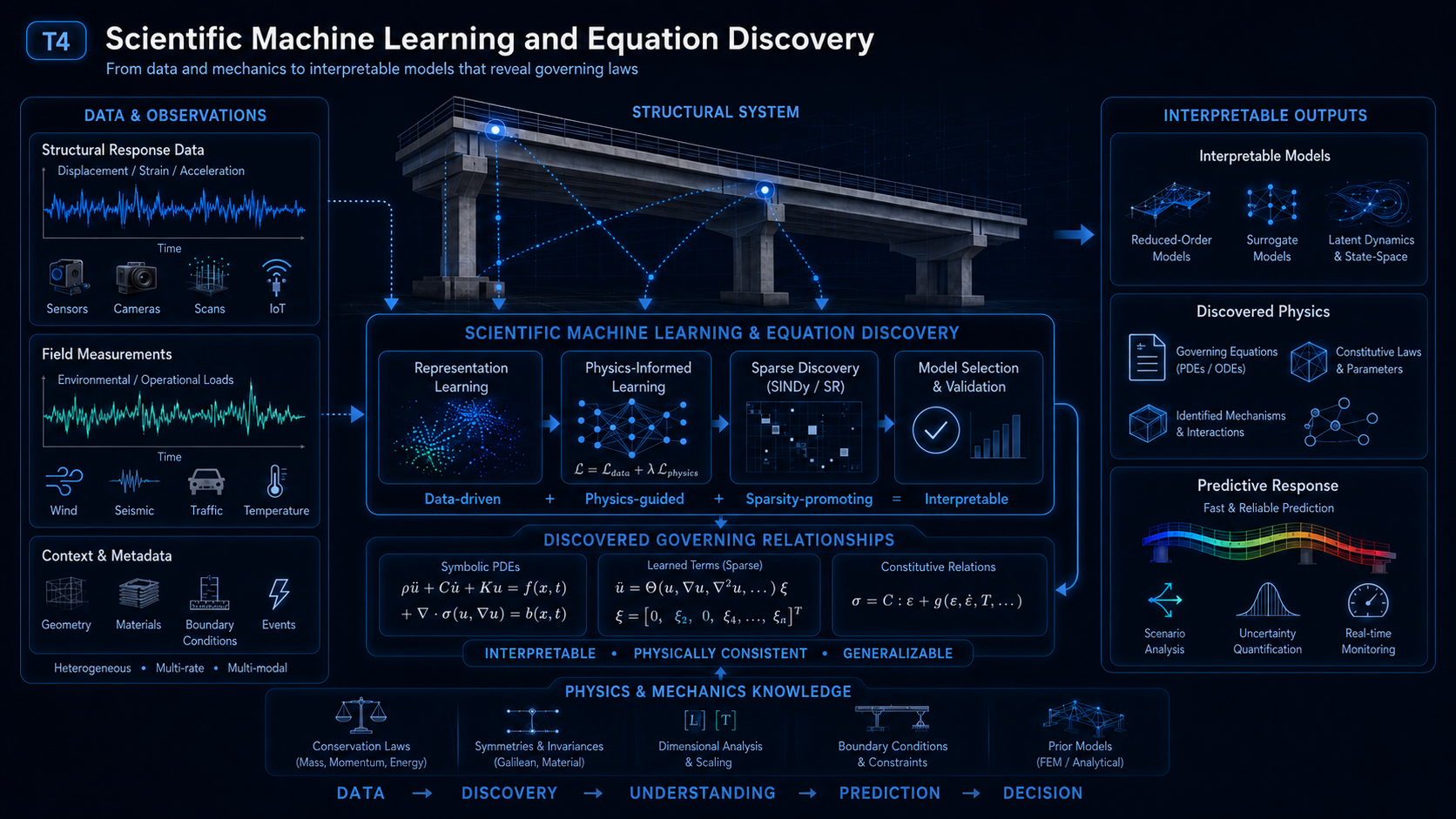
Scientific Machine Learning and Equation Discovery#
This thrust explores whether governing equations, reduced-order models, and interpretable dynamical descriptions can be discovered from structural response data.
The emphasis is on scientific machine learning methods that preserve interpretability and connect machine learning outputs back to mechanics.
Representative directions: output-only PDE discovery, sparse regression for structural dynamics, response-curve dictionaries, latent-space discovery, KAN-based scientific modelling.
T5
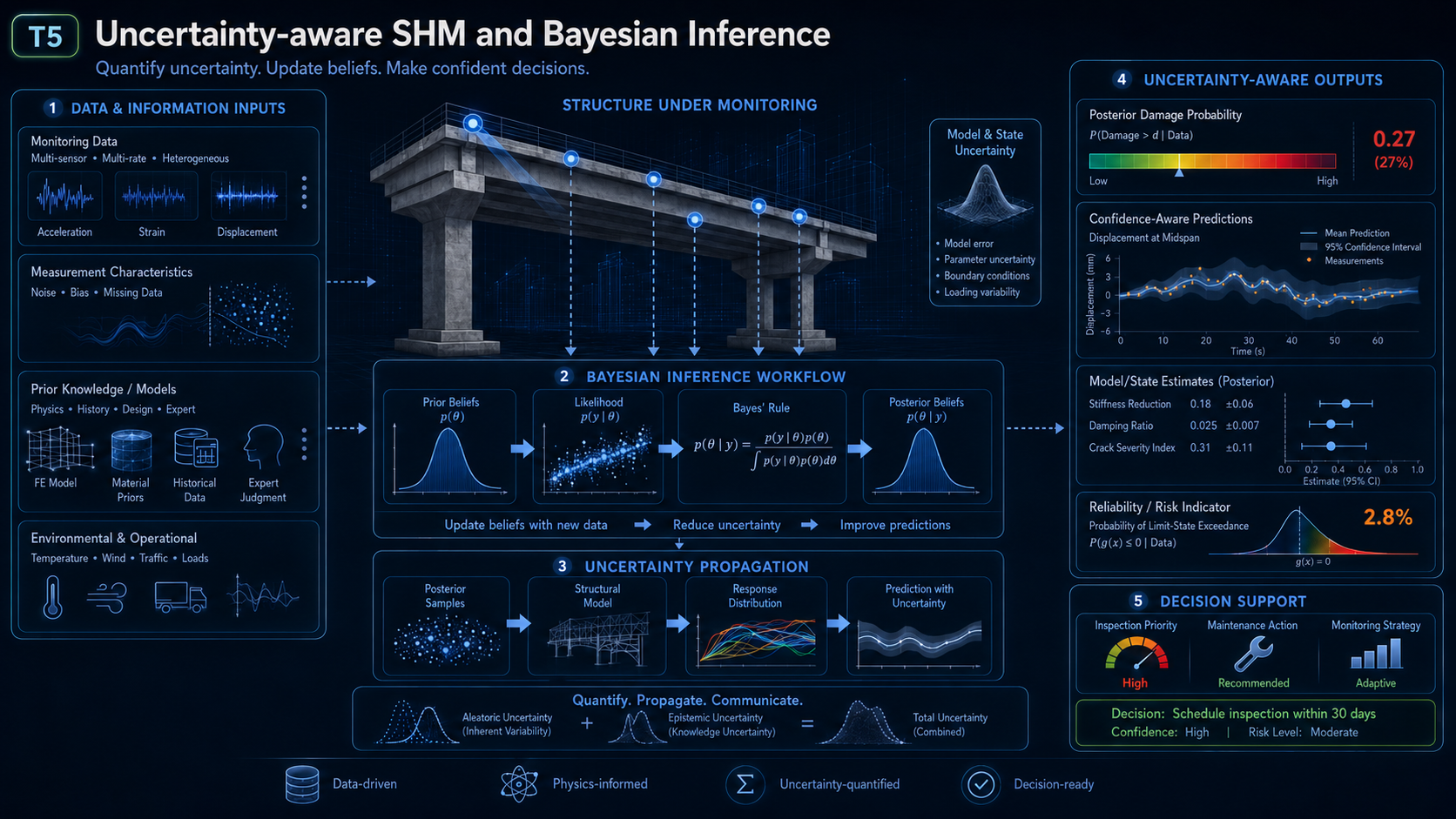
Uncertainty-aware SHM and Bayesian Inference#
This thrust addresses uncertainty in measurements, models, damage estimates, reconstructed signals, and digital twin predictions.
The objective is to make SHM outputs more useful for engineering decisions by quantifying confidence, ambiguity, and risk.
Representative directions: Bayesian uncertainty quantification, inverse damage analysis, prior modelling, uncertainty-aware signal completion, Monte-Carlo-style machine learning.
T6
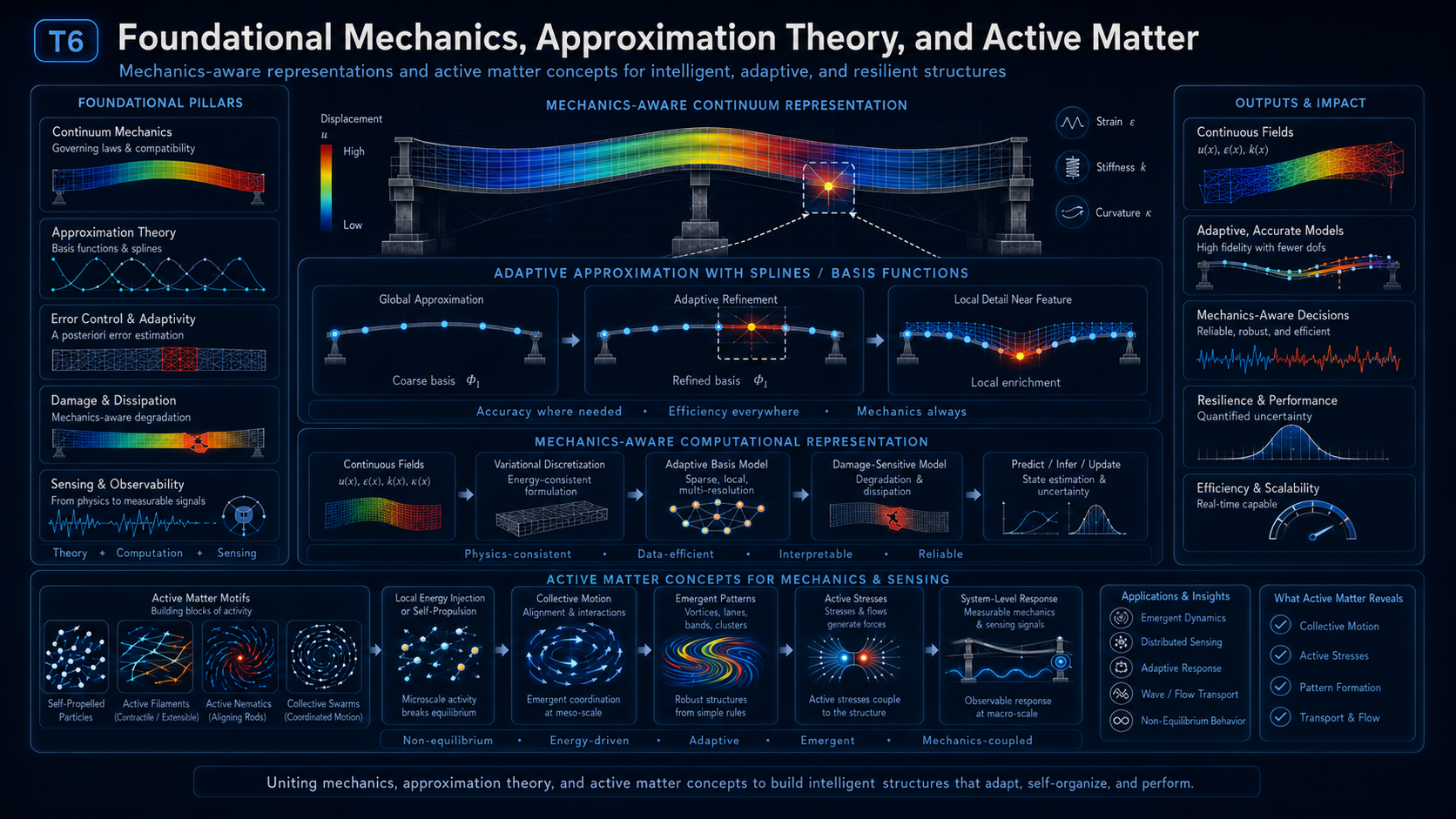
Foundational Mechanics, Approximation Theory, and Bio-inspired Sensing#
This thrust develops foundational methods that support the rest of the research program, including continuous-field representations, adaptive splines, meshless approximations, damage-sensitive shape functions, and unconventional sensing concepts.
The goal is to create new mechanics-aware representations and sensing ideas that can make damage detection and structural interpretation more robust.
Representative directions: adaptive splines, hybrid polynomial–B-spline fields, learned knot placement, continuous stiffness/damage fields, damage-sensitive finite element functions, bio-inspired mechanical sensing.
How the Research Program Fits Together#
From measurements to structural meaning
The first layer of the research program develops sensing, signal-processing, and computer-vision methods that extract reliable structural response from noisy, incomplete, and heterogeneous measurements.
From response to diagnosis
The second layer uses mechanics-guided features, response fields, wave propagation, splines, and learning algorithms to detect, localize, and interpret structural damage.
From diagnosis to digital twins
The third layer identifies structural properties, updates computational models, reconstructs full-field response, and builds data-informed digital twins for infrastructure systems.
From prediction to decision support
The final layer quantifies uncertainty and connects monitoring outputs to inspection, maintenance, rehabilitation, and risk-informed decision-making.